Work Schedule Posting Rules (TVöD & Beyond): Deadlines Explained
Work schedule posting rules explained: how far in advance a roster must be published under Germany's TVöD public-sector agreement, what the law actually requires, the works council's role – and what to do when no work schedule is posted.

Table of Contents
You work in the public sector and your schedule turns up at the last minute again? Then you are probably asking yourself about the work schedule posting rules that apply to you – and when a roster is simply too late. The short truth up front: the German public-sector agreement (TVöD) does not name a rigid posting deadline with a fixed day and time. Even so, you have clear rights. In this article you will learn which deadlines apply in practice, where they come from and what you can actually do when no schedule is posted at all.
The Key Points at a Glance
- The work schedule posting rules cannot be reduced to a single paragraph number – the deadline emerges from the interplay of the collective agreement, the works agreement and co-determination.
- In practice, public-sector employers usually apply an advance-notice period of one to two weeks before the start of the schedule period.
- The TVöD mainly governs working hours (§ 6 TVöD) – the concrete deadline is normally set by a works agreement with the staff council.
- There is no prescribed form: a notice board, an email or a digital scheduling app all satisfy the work schedule posting requirement.
- No work schedule – what to do? You can request the deadline in writing, involve your employee representation (staff or works council) and, under certain conditions, refuse short-notice changes.
Work Schedule Posting Rules Under the TVöD: The Short Answer
When it comes to the work schedule posting rules, the honest answer is: there is no nationwide deadline written word-for-word into the collective agreement. Anyone searching the TVöD for a sentence like "the schedule must be posted X days in advance" will come up empty.
That does not mean your employer may publish the roster whenever they like. The duty to announce the schedule in good time follows from the interplay of several sources: the employer's duty of care, the principle of reasonable discretion when exercising managerial authority (§ 106 of the German Trade Regulation Act), and above all from the relevant works agreement with the staff council.
What does "in good time" mean in practice? The benchmark is that you have enough lead time to plan your private life reliably – childcare, medical appointments, car-pooling or a second job cannot be reorganised from one day to the next. The shorter the lead time, the weightier the employer's interest must be to justify it.
In practice, an advance-notice period of at least one week has become established in the public sector. With flexible working-time models a shorter deadline of four days is sometimes agreed, while longer-term planning often runs to two weeks or a full month. What ultimately counts is the specific rule at your own organisation – which is exactly what we will look at next.
Work Schedule Posting Rules: What the Collective Agreement Actually Says
To answer the question of work schedule posting rules cleanly, it helps to look at what the collective agreement really contains – and what it does not.
§ 6 TVöD and Your Working Hours
§ 6 TVöD governs regular weekly working time in the public sector. So the paragraph defines how much you work and the framework within which working time may be distributed. It says nothing about when the finished roster has to be on the wall.
For shift and rotating-shift work, § 7 TVöD adds premiums and special provisions. Again, this is about pay and the timing of working hours, not about a fixed posting deadline. The actual deadline arises one level down.
Works Agreement and Staff Council: This Is Where the Deadline Comes From
The decisive lever is co-determination. Under the staff representation laws (§ 75 of the Federal Staff Representation Act, mirrored by § 87 of the Works Constitution Act in the private sector), the staff or works council has a co-determination right regarding the start and end of daily working time and the distribution of working time across the days of the week.
This means: without involving the staff council, the employer may not make co-determined rules on how working time is distributed. The accompanying works agreement then sets out, in binding terms, how much lead time the schedule must have. This is where you find the concrete answer for your organisation – not in the TVöD text itself. So take a look at your facility's works agreement or ask your staff council.
A typical example: a works agreement states that the roster for the coming month must be published by the 20th of the preceding month and that short-notice changes are only permitted after consulting the affected staff. Such rules are binding on both sides and create planning certainty – for you as an employee just as much as for management. Where no works agreement exists, the deadline can also arise from your individual contract or from established workplace practice; in that case what counts is how the employer has actually handled the roster up to now.
And in a medical practice? Worth knowing: the staff council (Personalrat) only exists in the public sector. Most medical practices are private businesses – there the works council (Betriebsrat) under § 87 BetrVG plays this role, and instead of the TVöD the MFA collective agreement usually applies. In smaller practices with ten to twenty employees, however, there is often no works council at all – it can be elected from five employees onwards, but is not mandatory. Where no such body exists, the deadline for announcing the roster follows from your employment contract or from established workplace practice.
Form of Announcement: Notice Board, Email or App?
A common assumption is that the plan must physically be posted on a wall. That is not the case. The work schedule posting requirement does not prescribe any particular form under labour law. The classic notice board, distribution by email or digital scheduling software are all fine. The only thing that matters is that every affected employee can actually take note of the plan in good time.
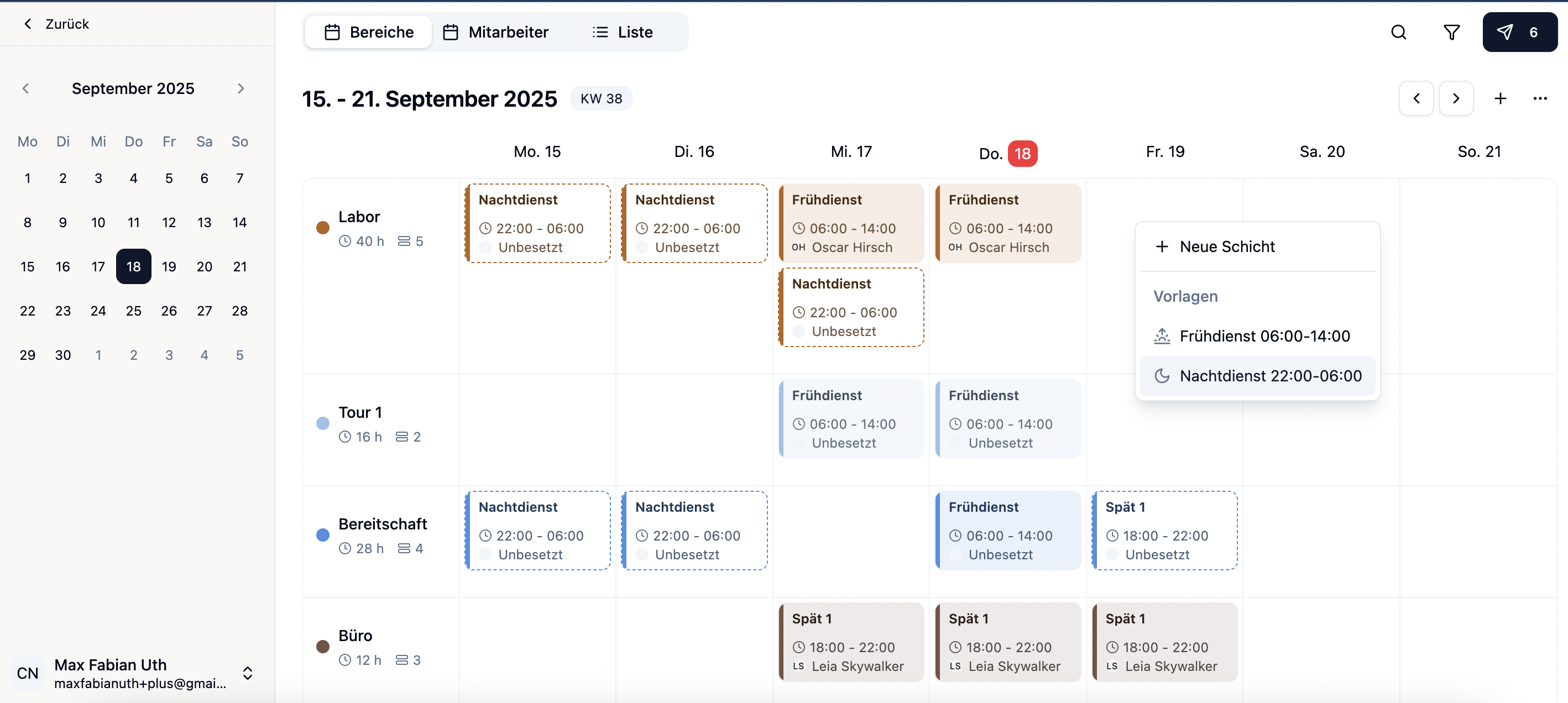 With medishift you create legally sound rosters, make them transparently available on every device and log every change without gaps. Try it for free!
Notice Periods at a Glance: TVöD, the MFA Agreement and No Agreement
The work schedule posting rules play out differently depending on your employment relationship. So you can place your own deadline quickly, here are the most important cases at a glance:
- TVöD / public sector: as a rule at least one week's lead time, sometimes four days for flexible models. This is set in binding form through the works agreement with the staff council.
- MFA collective agreement: medical assistants in practices are entitled, under the MFA collective agreement, to at least two weeks' notice as a rule.
- No collective agreement: here the vague standard of "in good time" applies. Many labour courts regard at least seven days as reasonable. A works agreement typically sets one to four weeks.
Hospitals and care facilities play a special role: the TVöD-K or TVöD-B often applies, and round-the-clock shift operations make forward planning indispensable. Precisely because early, late and night shifts alternate constantly, the notice periods in these institutions' works agreements are frequently especially detailed – including rules on how far in advance a complete shift plan must be set.
Above all deadlines stands the Working Hours Act (ArbZG): among other things, it prescribes at least eleven hours of rest between two shifts. A roster that violates this rule is invalid regardless of any posting deadline. For a detailed overview of your entitlements, see our guide to employee scheduling rights.
No Work Schedule – What to Do When Nothing Is Posted?
Theory is one thing – but no work schedule, what to do when the deadline has long passed and you still have no idea when you are working next week? You are not powerless here. The best approach is to proceed in this order:
- Send a written reminder: politely but in writing, point your employer to the applicable deadline from the works agreement. That puts your notice on record.
- Document the problems: note which disadvantages the late planning causes you, for example with childcare or medical appointments.
- Involve employee representation: if your organisation has a staff or works council, it is your most important ally – scheduling is, after all, subject to its co-determination. In a small practice without one, raise the issue directly with practice management.
- Check short-notice changes: you do not have to accept a roster announced far too late in every case if it causes you unreasonable disadvantages.
No work schedule, what to do when nothing moves at all? Then the formal route via the relevant employee representation remains – or, where none exists, a direct conversation with management and, if needed, legal advice. Important: in genuine emergencies, such as several simultaneous sick calls, labour law also expects a degree of flexibility from you.