Employee Scheduling Rights: Guide 2026
Learn everything about your scheduling rights as an employee: When must a schedule be ready, labor law regulations, and notification deadlines 2026.

Table of Contents
The Key Points at a Glance
- Employees have clear scheduling rights that are legally protected
- Legal deadlines regulate when schedules must be completed and announced
- Labor law has binding regulations on announcement and changes
- The question of how far in advance schedules must be provided varies by collective agreement
- Employee scheduling rights also include co-determination and objection possibilities
- Schedule changes are only permissible under certain conditions
Introduction: Your Most Important Scheduling Rights as an Employee
As an employee in a medical practice, clinic, or other healthcare facility, you probably often wonder: What scheduling rights do I actually have as an employee? Can my boss just change the schedule at short notice? And when must a schedule be ready so I can plan my free time?
The good news: Labor law regarding scheduling protects you from arbitrary scheduling. Employers must follow clear rules when creating, announcing, and changing schedules. In this comprehensive guide, I'll explain all important employee scheduling rights so you know exactly what you're entitled to and how to assert your rights.
When Must a Schedule Be Ready? Legal Deadlines Overview
One of the most common questions is: When must a schedule be completed? The answer isn't quite simple, as there's no uniform legal regulation in labor law. The specific deadlines depend on various factors.
General Legal Foundations
In labor law regarding scheduling, there's no nationwide deadline prescribing when a schedule must be ready. Instead, the rule is: Announcement must occur "in good time." What "in good time" means is based on collective agreements, works agreements, and industry standards.
Most labor courts consider a minimum deadline of 7 days as appropriate. This deadline allows you as an employee to plan your free time accordingly. For shorter deadlines, special reasons must exist.
Collective Agreement Regulations
Many employees in the public sector wonder about schedule announcement requirements. Public sector collective agreements have clear specifications:
Public Sector Regulations:
- Schedules must be announced at least one week before the start of the validity period
- With flexible working time models, a 4-day deadline can be agreed
- In emergencies, shorter deadlines are possible but must be justified
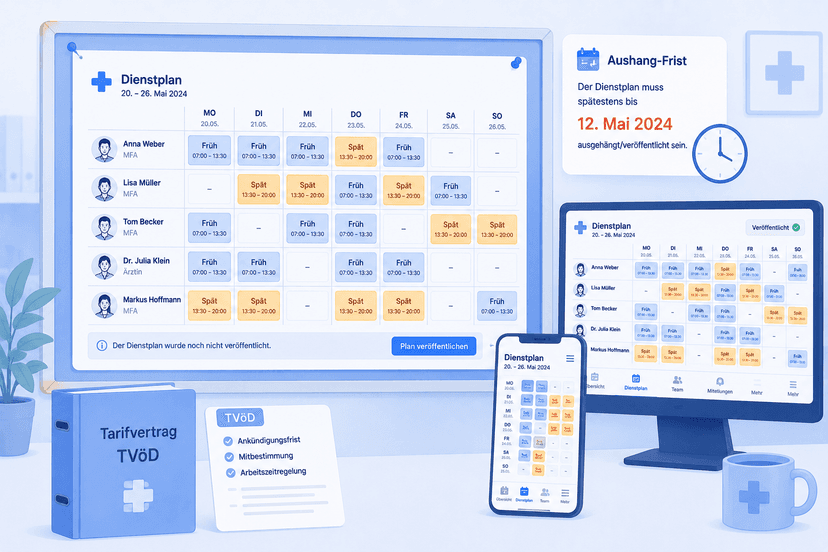
Other collective agreements, such as the Medical Assistant Collective Agreement, require at least 2 weeks' advance notice. The specific deadline for how far in advance schedules must be provided strongly depends on the respective collective agreement. We cover the public-sector specifics in detail in our guide to the work schedule posting rules under the TVöD. In practice scheduling, these deadlines should definitely be observed.
Works Agreements and Individual Regulations
If no collective agreement applies, works agreements can regulate when a schedule must be ready. These have the advantage of being tailored to the company's specific needs and typically establish lead times of 1-4 weeks.
The employment contract can also specify how far in advance schedules must be announced. These contractual regulations are binding for both parties and can specify your employee scheduling rights.
Labor Law and Scheduling: The Most Important Legal Foundations
Labor law regarding scheduling is based on various laws and regulations that protect your employee scheduling rights.
The Working Time Act as Foundation
The Working Time Act is the most important legal foundation for labor law regarding scheduling. It regulates:
Maximum Working Hours:
- 8 hours per day as regular working time
- Exceptionally 10 hours, if an average of 8 hours isn't exceeded within 6 months
- At least 11 hours rest time between two work shifts
Breaks and Rest Periods:
- For 6-9 hours: at least 30 minutes break
- For over 9 hours: at least 45 minutes break
- Break times don't count as working time
These regulations must be observed in every schedule. A schedule that violates the Working Time Act is invalid. Modern practice management tools help automatically verify these requirements.
Employer's Right to Direct vs. Employee Scheduling Rights
In labor law regarding scheduling, the employer's right to direct faces employee scheduling rights. The right to direct allows the employer to determine working time, location, and content – but not without limits.
Limits of the Right to Direct:
- Legal protective provisions (Working Time Act, Maternity Protection, etc.)
- Collective agreement regulations
- Works agreements
- Principle of fairness
The employer must also consider your legitimate interests: family obligations like childcare, health restrictions, and work-life balance compatibility.
Labor Law Schedule Announcement: Deadlines and Formal Requirements
Labor law schedule announcement is subject to strict rules. Employers cannot simply announce at short notice when you must work.
Timely Information as Employee Protection
Timely labor law schedule announcement is an important aspect of employee scheduling rights. It allows you to:
- Plan private appointments
- Organize childcare
- Attend medical appointments
- Coordinate leisure activities
Without sufficient lead time, you may be able to refuse schedule changes under certain circumstances. The question of how far in advance schedules must be provided is therefore decisive for your planning security.
Form of Announcement: Digital vs. Notice Board
Labor law regarding scheduling doesn't prescribe a specific form of announcement. Common are notice board postings, email distribution, or scheduling apps like medishift. What's important is that all employees can actually take notice.
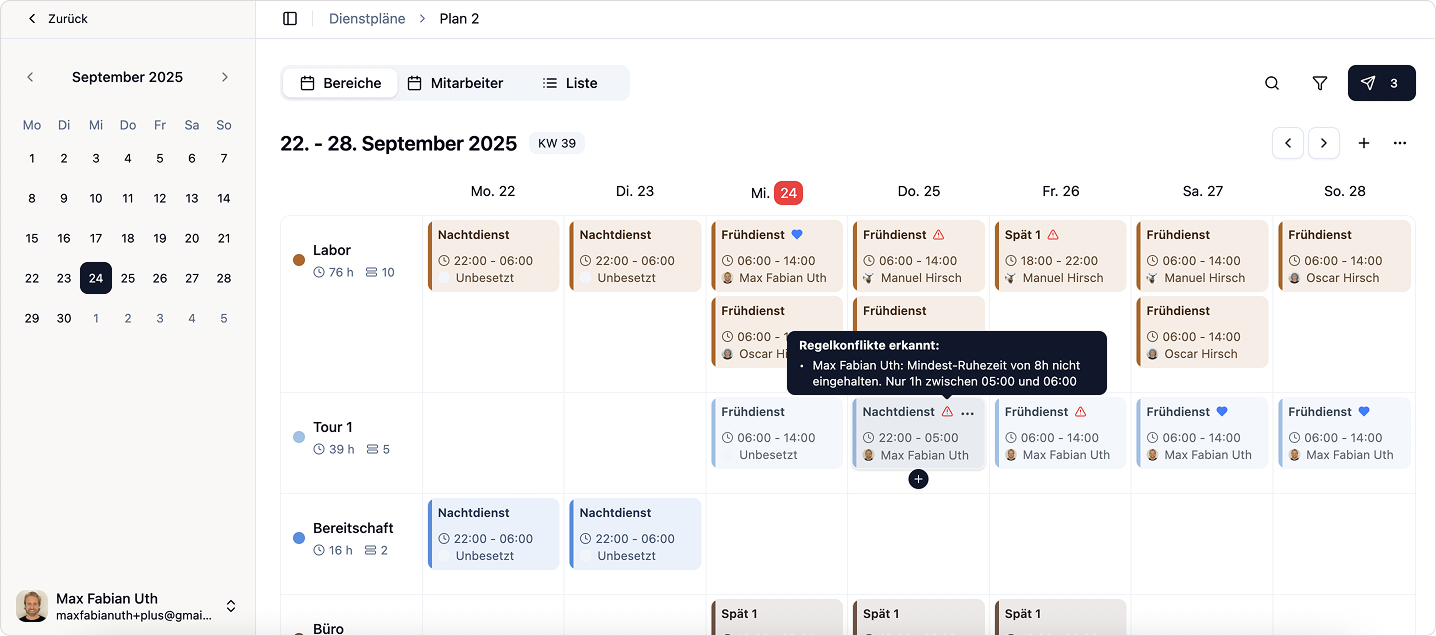 With medishift, you receive your schedule on time and transparently on all devices – legally secure and fair.
Schedule Changes: What's Permitted, What's Not?
A central question regarding employee scheduling rights is: Can my boss just change the schedule?
Permissibility of Subsequent Changes
Basically: An announced schedule is binding. Changes are only permitted under narrow conditions.
Permissible Reasons for Schedule Changes:
- Unforeseeable operational emergencies (e.g., multiple employees calling in sick)
- Extraordinary operational requirements
- Consensual changes with the affected employee
Not Permissible Reasons:
- Poor planning by the employer
- Mere convenience
- Arbitrary redistribution of shifts
Labor law regarding scheduling requires that changes be proportionate. The shorter the notice for the change, the more serious the reason must be.
Participation Rights and Objection Possibilities
Your employee scheduling rights also include the right to object to schedule changes. You can object to a short-notice change if:
- You have important private obligations (medical appointment, childcare)
- The change is unreasonable
- The lead time is too short
- The employer doesn't observe labor law schedule announcement deadlines
With genuine emergencies, however, you also need to be flexible. Labor law regarding scheduling requires willingness to compromise from both sides.
Works Council Co-Determination Rights in Scheduling
If there's a works council in your company, this significantly strengthens your employee scheduling rights.
According to Works Constitution Act § 87 para. 1 no. 2, the works council has co-determination rights regarding start and end of daily working hours, breaks, and distribution of working hours across individual weekdays.
This means: Without works council approval, the employer may not create schedules. The question of when a schedule must be ready is then often bindingly regulated in works agreements.
For violations of your employee scheduling rights, you can inform the works council or file a formal complaint under Works Constitution Act § 84.
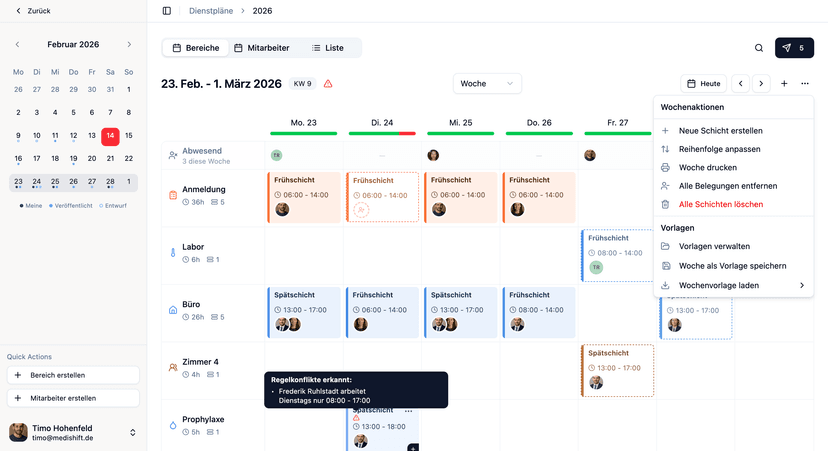

Try Medishift for free now!
- Modern duty planning in just minutes
- Automated workflows for your practice
- Forever free for up to 10 employees
Specifics in Medical Practices and Healthcare
Special regulations for employee scheduling rights apply in healthcare.
Office Hours, Emergency Services, and On-Call Duty
In medical practices, schedules must meet special requirements. The employer determines when the practice is open but must observe labor law schedule announcement. On-call duties fully count as working time and must be included in the schedule.
Rights of Medical Assistants and Practice Staff
Medical assistants have additional protection through the Medical Assistant Collective Agreement: minimum lead times usually of 2 weeks and special protective provisions for part-time staff. Special provisions apply to pregnant employees: employment bans and no night or weekend work.
The practice manager plays a key role in compliance with employee scheduling rights: They must find the balance between operational requirements and employee interests and use modern tools for fair scheduling.
Frequently Asked Questions About Employee Scheduling Rights
Conclusion: Know Your Employee Scheduling Rights
Employee scheduling rights are important protection for your work-life balance. Labor law regarding scheduling provides clear framework conditions that employers must observe.
The most important points summarized:
- When must a schedule be ready: At least 7 days, often 2-4 weeks according to collective agreement
- Labor law schedule announcement: Must occur in good time and transparently
- How far in advance schedules must be provided: Depends on collective agreement and works agreement
- Changes only with important reason and appropriate justification
- Works council significantly strengthens your employee scheduling rights
As an employee, you should know your rights and also assert them. Modern scheduling tools like medishift help automatically consider all legal requirements and create fair schedules. This benefits both sides: Employers have legal certainty, employees have planning security.