German Collective Agreement: Medical Assistants
German collective agreement for medical assistants 2026: 38.5 to 40 hours per week, 28 to 30 vacation days. How regions differ - and what changes.
Table of Contents
As a Medical Assistant (MFA) or practice manager, you probably often wonder: What am I actually legally entitled to? How are working hours for medical assistants regulated? And what's changing in the collective agreement for 2026? The collective agreement forms the legal basis for working conditions, working hours, and many other important aspects of your daily work.
Many MFAs and practice owners are unsure which regulations of the collective agreement they must comply with. This is understandable, as the collective agreement landscape is complex and differs significantly by region.
In this guide, I'll explain everything important about the collective agreement for medical assistants: from working hour regulations to regional differences to practical tips for daily work.
The Key Points at a Glance
- The collective agreement regulates working hours, vacation, overtime, and working conditions
- MFA working hours are usually 38.5-40 hours per week with a 5-day week
- Medical assistant working hours can be flexibly structured
- Regional differences: Different regions have different regulations
- The 2026 collective agreement brings improvements in salary and working hours
- Overtime must be correctly recorded and compensated
- Modern scheduling systems help with agreement-compliant implementation
Basics of the Collective Agreement for Medical Assistants
The collective agreement is a collective bargaining agreement between unions and employer associations that regulates the basic working conditions for medical assistants. Unlike salary agreements, it establishes the "framework conditions": working hours, vacation entitlements, notice periods, and continuing education entitlements.
The collective agreement generally only applies to practices bound by the agreement and union members. However, it's frequently used as guidance or agreed upon in individual contracts.
Important: Each region has its own collective agreement with considerable differences. Regional agreements can differ significantly from each other.
MFA Working Hours and Working Time Regulations
Weekly Working Hours According to Collective Agreement
Working hours for medical assistants are one of the most important topics in the collective agreement. Regular weekly working hours vary by region:
Typical Weekly Working Hours:
- Most regions: 38.5 hours/week
- Some eastern regions: 39-40 hours/week
These working hours refer to a 5-day week. For 6-day weeks (which occur in practices with Saturday opening), correspondingly adjusted daily working hours apply.
Daily Working Hours, Breaks, and Flexible Models
Medical assistant working hours are subject to labor law:
- Maximum daily working time: 8 hours (exceptionally 10 hours)
- Minimum break: 30 minutes for 6-9 hours, 45 minutes for over 9 hours
- Rest time: At least 11 hours between end of work and start of work
The collective agreement allows flexible working hours for medical assistants:
- Flextime: Usually with core hours 9:00-15:00
- Part-time: Basic entitlement where positions are available
- Job sharing: Two MFAs share one full-time position
Modern practice scheduling considers these flexible models.
Overtime, On-Call Duty, and Supplements
With medical assistant working hours, a clear distinction must be made between regular working time and overtime. Overtime occurs when the collectively agreed working hours are exceeded.
Overtime Regulations in the Collective Agreement:
- Overtime must be ordered or approved by the employer
- Compensation with supplements (usually 25% on basic pay)
- Alternatively: Time off in lieu at a ratio of 1:1.25
- Documentation obligation for employers
The collective agreement regulates special working hours for medical assistants:
- On-call duty (on-site): Presence at the practice counts fully as working time
- Standby duty: Availability at home, only actual work time is fully compensated
For special working hours, the collective agreement provides supplements:
- Night work (usually 8 PM - 6 AM): 20-25% supplement
- Saturday work: 25% supplement
- Sunday and holiday work: 50-100% supplement
These supplements may vary depending on region and specific agreement.
Regional Variations and 2026 Updates
Regional Differences
Regional agreements have their own characteristics:
- Weekly working hours: Vary from 38.5 to 40 hours
- Vacation entitlement: 28-30 working days per year
- Notice periods: Graduated by length of service
- Continuing education: Special leave provisions
The collective agreement landscape varies considerably by region:
North/West: 38.5-39 hours/week, 28-30 vacation days Southern regions: 38.5 hours/week, 30 vacation days, highest salaries Eastern regions: 39-40 hours/week, 28-29 vacation days
Updates in the 2026 Collective Agreement
The 2026 collective agreement brings improvements in three core areas:
- Working time flexibilization: More flexible working hours for medical assistants
- Digitalization: Adaptation to modern practice organization
- Continuing education: Expanded training entitlements
The 2026 collective agreement provides for salary increases in most regions:
- Linear increases between 3-5% depending on region
- Special improvements for career starters
- Additional allowances for special qualifications
- Improvement of compensation for overtime and supplemented working hours
The updates in the 2026 collective agreement require adjustments in practice organization:
Working time documentation: More precise documentation of MFA working hours becomes more important Scheduling: More flexible working time models must be considered in scheduling Cost planning: Higher personnel costs require better calculation
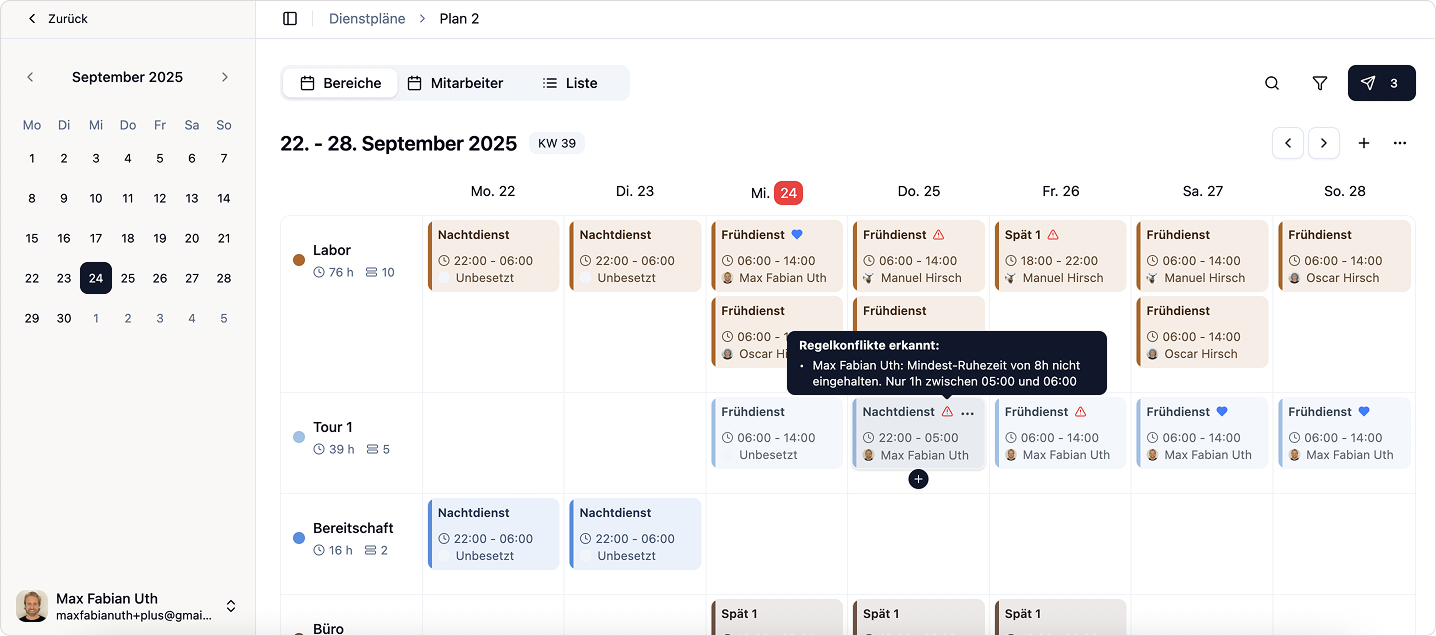 Modern apps like medishift help with agreement-compliant scheduling of MFA working hours.
Overtime Documentation and Time Tracking
With medical assistant working hours, correct recording of overtime is legally important. The collective agreement defines overtime as working time that exceeds the collectively agreed MFA working hours.
Important Distinctions:
- Overtime: Beyond collectively agreed working hours (e.g., more than 38.5h/week)
- Additional hours: Beyond legal working hours (more than 8h/day or 48h/week on average)
- Voluntary extra work vs. ordered overtime
The collective agreement regulates overtime compensation:
- Payment with 25% supplement
- Time off in lieu at a ratio of 1:1.25
- Combination of both
Time off in lieu usually occurs within 6 months, or up to 12 months for operational reasons.
Employers must document:
- Daily MFA working hours including breaks
- Overtime and approvals
- Time off in lieu and remaining vacation
Modern scheduling systems like medishift help with organizing working hours through planned shifts, ensuring agreement-compliant scheduling.
Vacation, Continuing Education, and Occupational Health
Vacation Entitlements and Special Leave
The collective agreement provides for more vacation than legally required:
- Most regions: 28-30 working days
- Minimum legal requirement: 20 days
For other medical assistant working hours (part-time), vacation is calculated proportionally.
The collective agreement also regulates paid special leave (wedding, birth, bereavement, moving).
Vacation planning in medical practices considers MFA wishes and operational needs. In case of conflicts, social criteria decide - parents of school-age children have priority during school holidays.
Continuing Education and Job Protection
The collective agreement regulates professional development:
Leave:
- Paid for mandatory training
- Partially paid for voluntary training
- Educational leave according to state laws
Cost Support:
- Full coverage for mandatory training
- Partial coverage for voluntary training
- Bonus systems for successful qualifications
The collective agreement provides for longer notice periods:
- Up to 2 years: 6 weeks to end of month
- 2-5 years: 3 months to calendar quarter
- 5-8 years: 4 months to calendar quarter
- Over 8 years: 5 months to calendar quarter
Extended job protection applies to pregnant employees, disabled workers, works council members, and MFAs in training.
Occupational Health and Safety
Medical assistant working hours are subject to special protective provisions for biological working materials, X-ray radiation, and psychological stress.
The collective agreement regulates occupational health care: X-ray examinations, hepatitis B vaccinations, and computer workstation checks.
Maternity Protection and Parental Leave: Adjustment of MFA working hours for health issues, up to 3 years parental leave with part-time option, and return guarantee.
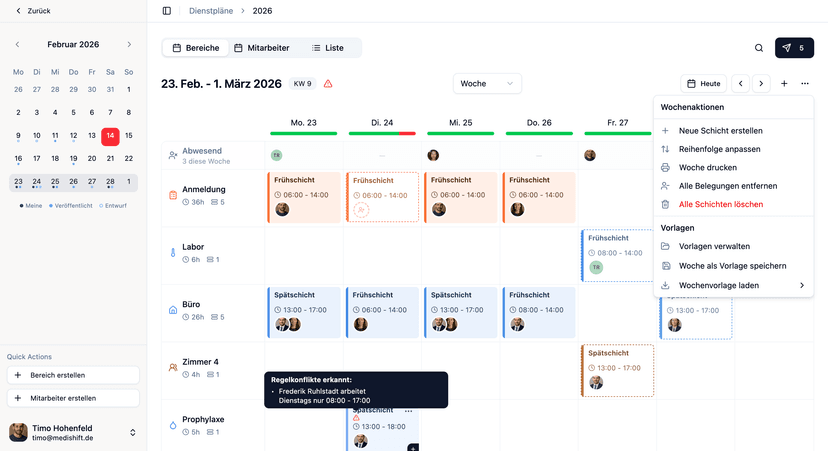

Try Medishift for free now!
- Modern duty planning in just minutes
- Automated workflows for your practice
- Forever free for up to 10 employees
Digitalization and Modern Work Organization
Digitalization is changing medical assistant working hours: Home office, mobile time tracking, digital scheduling, and telemedicine are creating new forms of work.
Modern scheduling systems offer mobile availability and transparent shift planning. Systems like medishift help organize working hours through planned shifts.
Practical Implementation and Future Outlook
Implementation for Practice Owners and MFAs
Practice Owner Checklist:
- Document MFA working hours correctly
- Implement overtime regulations
- Systematize vacation planning
- Introduce modern scheduling system
Compliance with the collective agreement causes higher personnel costs but brings employee satisfaction and less turnover.
MFA Rights:
- Agreement-compliant MFA working hours and overtime compensation
- Full vacation entitlement and continuing education claims
- For problems: Contact practice management, union, or labor law advisor
Future Trends in MFA Collective Agreements
The development of collective agreements shows clear trends: Flexibilization of medical assistant working hours, better work-life balance, integration of digital processes, and upgrading of the MFA profession.
Challenges include skills shortages, demographic change, and new technologies. Practices need more modern scheduling and better vacation planning.
Proactive practices position themselves as attractive employers and attract the best MFAs.
Frequently Asked Questions About the MFA Collective Agreement
Conclusion: The Collective Agreement as Foundation for Fair Working Conditions
The collective agreement forms the foundation for fair working conditions for medical assistants. Understanding collective agreement regulations is essential for both MFAs and practice owners.
For MFAs: Know your rights, ensure correct MFA working hours recording, use continuing education entitlements, and don't hesitate to assert your rights.
For Practice Owners: The collective agreement is an important reference framework. Correct time recording of medical assistant working hours is legally important, and fair working conditions are a competitive advantage.
The 2026 collective agreement brings improvements. Regional differences from various agreements show the importance of region-specific knowledge.
The future of medical assistant working hours is characterized by flexibility and digitalization. At medishift, we help you effortlessly meet all collective agreement requirements.
Investment in fair working conditions pays off for everyone involved.