Advance Vacation Planning Rights: Rules & Deadlines
Advance vacation planning rights explained: how early the leave schedule must be finalized, what the German BUrlG actually says, and what rights you have as an employee or practice owner. All rules and practical tips for medical practices.

Table of Contents
"When does my boss actually have to finalize next year's leave schedule?" — you hear this question in almost every medical practice sometime between November and January. The answer is surprisingly clear in law, but barely known in most practice teams. Advance vacation planning rights give you, as an employee, concrete claims — and give your practice owner, as an employer, concrete obligations. In this guide you will learn which deadlines apply, by when the vacation plan must be finalized, and what rights you have if your leave requests are ignored.
Key takeaways at a glance
- Advance vacation planning rights obligate the employer to consider every employee's leave wishes in time and fairly
- According to the vacation planning law (§ 7 BUrlG, the German Federal Leave Act) your colleagues' requests are binding unless urgent operational reasons stand against them
- The question "when must vacation planning be finalized" has no single statutory deadline — in medical practices, a yearly plan by the end of January has become the common standard
- Statutory annual leave must as a rule be taken by 31 December; a carryover into the next year is only permissible under narrow conditions
- In a conflict the employer decides — but not arbitrarily, because social criteria such as school holidays, caregiving, or health must be weighed
- A digitally maintained leave schedule for the whole team protects both sides and creates transparency
Why advance vacation planning rights matter so much
In a medical practice, vacation is more than a private matter. Every absence has to be covered by colleagues, substitute physicians have to be booked, and appointment blocks have to be adjusted. That is precisely why advance vacation planning rights exist — they create planning certainty for both sides.
For you as an employee, early planning means you can book your trips before flights become expensive, tell your family when the joint holiday is happening, and know reliably when you are off. For your practice it means enough lead time to spot bottlenecks, organize substitutes, and reschedule patient appointments in an orderly way.
When advance vacation planning rights are ignored, problems pile up on both sides: employees feel overlooked, the team atmosphere sours, expensive last-minute substitutes become necessary, and in the worst case patients have to be rebooked on short notice. Practice owners often underestimate how quickly poorly managed leave planning turns into a reason to quit — in times of a staff shortage, an expensive mistake.
The statutory minimum leave under the Federal Leave Act (BUrlG) is 24 working days per year on a six-day week, which is 20 working days on the five-day week typical of medical practices. Most MFA collective agreements grant significantly more, often 28 to 30 days — and exactly this amount of leave needs to be coordinated well in advance.
What the vacation planning law actually says
The most important German statute on leave is the Federal Leave Act (Bundesurlaubsgesetz, BUrlG). § 7 paragraph 1 BUrlG is the heart of the vacation planning law framework and says in essence: when scheduling leave the employer must consider the employee's wishes, unless their consideration conflicts with urgent operational reasons or with the leave requests of other employees who deserve priority on social grounds.
For you that means: your wish is in principle binding. Your boss may only reject it if one of two grounds applies. First: urgent operational reasons. In a medical practice that would be, for example, a planned certification, a new branch opening, or a substitute doctor already booked. Second: leave wishes of colleagues that socially outrank yours — perhaps because a colleague has school-aged children and depends on school holidays.
The BUrlG contains more rules you should know. § 7 paragraph 2 requires that leave be granted as a connected block — meaning at least once per year, at least two full weeks in a row. This is not negotiable and means: your boss is not allowed to split you into scattered single days or bridge days just because that fits better into the duty schedule.
The third important point from the Federal Leave Act concerns expiry. In principle, leave must be taken within the current calendar year. A carryover into the following year is only permissible for urgent operational reasons or reasons in your person — and then only until 31 March. Since the Federal Labor Court's decision of 19 February 2019 it also applies that the employer must actively and specifically prompt you to take your leave — otherwise it does not expire at all.
This combination of entitlement, social weighing, and duty to inform is the core of vacation planning law — and exactly the reason why structured advance vacation planning rights are not optional but an obligation on the employer's side.
When must vacation planning be finalized?
Now for probably the most common question of all: when must vacation planning be finalized? Honestly — there is no uniform statutory deadline. Neither the BUrlG nor the Working Time Act names a concrete date by which the annual leave plan must be in place.
That sounds at first like a gap in the law, but it is deliberate: the legislator leaves the concrete timing to collective agreements, works council agreements, and company practice. Still, in healthcare a clear standard has emerged. The answer to "when must vacation planning be finalized" in most medical practices is: by the end of January of the current year, at the latest by the end of February. Many practices even start collecting requests for the coming year back in November.
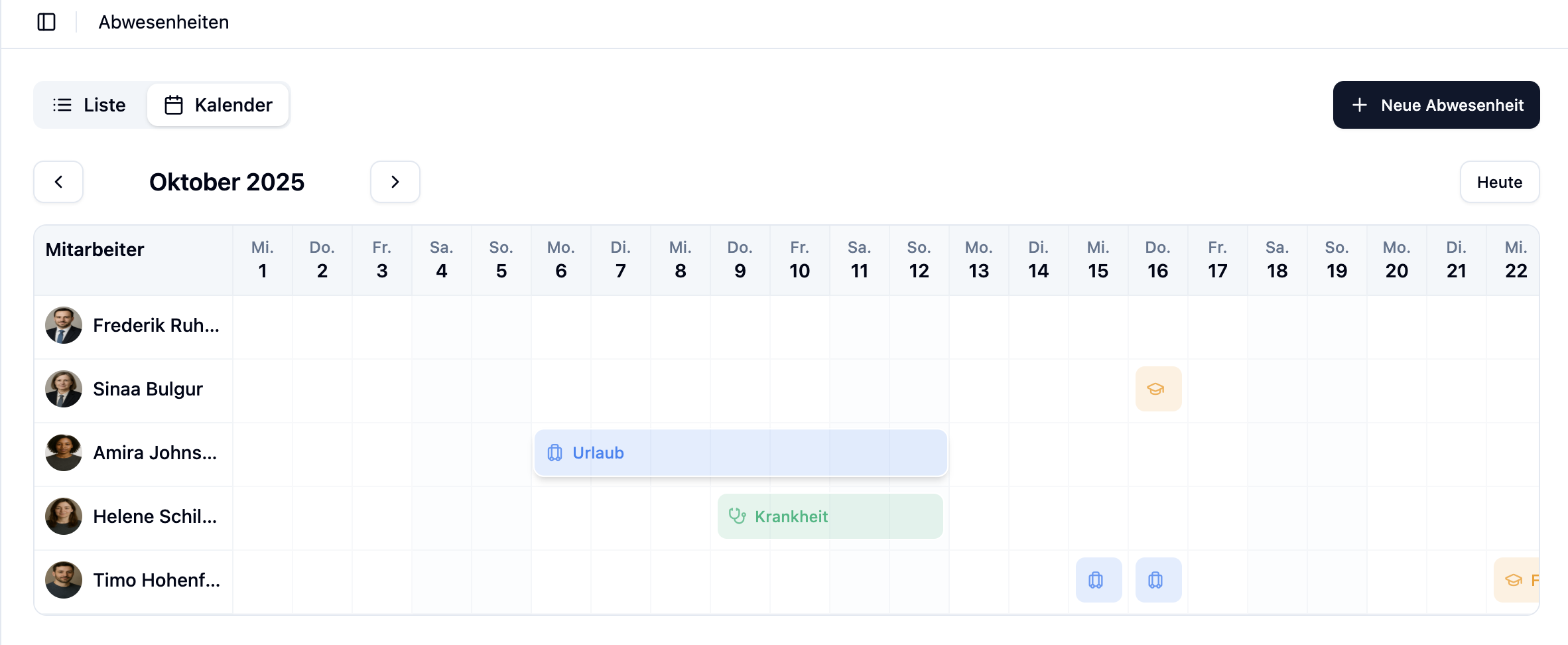 With medishift you keep the annual leave schedule of your whole team in view — transparent, traceable, and legally sound. Try it for free!
In a well-organized practice it works like this: by the end of November, requests for the following year are collected. By mid-December, the practice manager reviews the requests, highlights conflicts, and negotiates solutions with the team. By early January a binding annual plan is in place. That way the question "when must vacation planning be finalized" is effectively answered, and everyone has planning certainty.
If your practice is bound by a collective agreement — for example the framework agreement for medical assistants (MFA) — that agreement may contain more concrete deadlines. A glance at your contract is therefore worthwhile. And even without a collective agreement, the general duty of care owed by the employer implies that planning must happen in time for employees to realistically start their holiday — anyone who still does not know their summer holiday in July will no longer find affordable flights.
Advance vacation planning rights: your rights as an employee
Advance vacation planning rights give you, as an employee, far more leverage than most realize. Here are the most important ones you should know.
Your right to choose
Under § 7 paragraph 1 BUrlG you have an express right to request specific dates. You do not have to justify, explain, or ask permission. You submit your request — and your employer must consider it unless one of the two rejection grounds applies. This is the central lever of the law: your wish is the starting point, not the boss's generosity.
Social priority
If several colleagues want the same period, the employer cannot simply toss a coin or decide by seniority. They must weigh social criteria: school-aged children, a partner's leave dates, health needs, caregiving duties for relatives. A single mother with two school children normally has priority over a childless colleague without any particular tie. That does not mean parents always win — but their argument is stronger when wishes are otherwise equivalent.
Connected leave
You have a right to receive at least twelve connected working days — about two full weeks — in one block at least once per year. Your boss cannot splinter your leave into isolated days just because that would be simpler to schedule. This entitlement is hard-wired into the statute and is not negotiable.
Protection against withdrawal
Once your leave has been approved in writing, it may only be revoked in absolute emergencies. The employer then has to prove the emergency and reimburse you for all resulting costs — including cancellation fees for flights and hotels already booked. In practice, when the employer respects the advance-planning rules, a withdrawal practically never happens.
The employer's duty to inform
Since 2019 the rule is: your boss must actively and specifically inform you when you still have unused leave, and clearly tell you by when it would expire. If they do not, your leave does not expire — it stays with you, even after the calendar year is long over. This is one of the strongest levers of modern advance vacation planning rights.
Conclusion: advance vacation planning rights, implemented digitally
Advance vacation planning rights are not a nice-to-have but a legal obligation with real consequences. Those who take them seriously protect themselves from conflicts, save last-minute costs, and retain their team long-term. Those who ignore them risk resignations, damage claims, and reputational harm inside the team.
The good news: with the right software, implementation is simple. A digitally maintained annual leave schedule shows at a glance who requested leave when, who has already been approved, and where overlaps are looming. Medishift calculates each employee's leave balance automatically — including carryovers, location-specific public holidays, and half-day absences. When approving a new absence, the system automatically warns you if colleagues in the same work area are already away at the same time. That way you resolve the classic leave conflict before it even arises.
Employees, in turn, see their leave balance directly in their dashboard, request absences with just a few clicks, and keep an overview of approved and pending requests. That makes advance vacation planning rights transparent, traceable, and legally sound — exactly as the Federal Leave Act prescribes.
For more on the topic, read our detailed article on vacation planning in the medical practice and on general duty schedule rights for employees. If you want to set up your leave planning professionally right now, try medishift for free — and turn your practice's annual leave into a relaxed topic for the first time in years.