Shift Schedule Change Law: Notice Periods, Employee Rights and Special Cases
Shift schedule change law explained: What notice period applies? Can your boss change the shift schedule on short notice? Practical guide to Section 106 GewO, German Federal Labour Court rulings and special cases — specifically for medical practices and MFA teams.

Table of Contents
The schedule is up, you're planning your week — and on Wednesday the boss suddenly writes that you should jump in Friday evening after all. Can he do that? And what notice period does shift schedule change law in Germany actually require? This article answers exactly those questions. You'll learn what German employment law says about notice periods, when your boss can legally change the shift schedule on short notice and when not, and what you can do if the notice period isn't honored. The focus is on the right of direction under Section 106 of the German Trade Regulation Act (GewO), the Working Hours Act, and rulings from the Federal Labour Court — plus the concrete reality inside a medical practice.
Key takeaways at a glance
- The term shift schedule change law is not a single statute but a combination of Section 106 GewO, the Working Hours Act (ArbZG), the Works Constitution Act and collective bargaining agreements.
- As a rule of thumb established by Federal Labour Court rulings, a shift schedule notice period of at least 4 days applies. Many collective bargaining agreements specify 7 or even 14 days.
- The boss may change the shift schedule on short notice when there's an urgent operational reason (e.g. illness), but not arbitrarily and never in violation of the 11-hour rest period.
- If the boss tries to change the shift schedule against employment law, you can object, document the extra work and turn to the works council, union or a specialist lawyer — the most common question "can my boss change the shift schedule" therefore has a clear, but nuanced, answer.
- A shift schedule change is only legally effective if it has been demonstrably communicated to you — verbal orders are hard to prove later.
Shift Schedule Change Law: These legal foundations apply
There's no single paragraph in German law titled "shift schedule change". Instead, several rules interlock that together form the shift schedule change law in the broader sense. There are three sources you should know before we get to the actual question "can my boss change the shift schedule".
Section 106 German Trade Regulation Act — the right of direction
The classic. Under Section 106 GewO, the employer may determine the content, location and time of work "at his reasonable discretion", as long as the employment contract, collective bargaining agreement or works agreements don't say otherwise. This generally also covers shift schedule changes — but "reasonable discretion" is a hard limit. The boss has to weigh your interests (family, free time, recovery, medical appointments) against operational interests. An arbitrary change the night before without an urgent reason doesn't hold up — and that's exactly where the keyword "change shift schedule employment law" comes in.
Working Hours Act (ArbZG)
The Working Hours Act sets hard limits that apply to every shift schedule change:
- Maximum 8 hours per workday (up to 10, if the average over 24 weeks can be balanced out)
- At least 11 hours rest period between two shifts
- Break times depending on shift length (30 min from 6h, 45 min from 9h)
If your shift schedule is changed on short notice in a way that would violate one of these limits, the order is simply ineffective. You don't have to take such a shift — that's not refusing to work, it's law-abiding.
Co-determination and collective bargaining agreements
In practices or clinics with a works council, the council has, under Section 87 (1) No. 2 of the Works Constitution Act, an enforceable co-determination right over the start and end of daily working time — and therefore also over the shift schedule and its changes. Without the works council's consent, collective shift schedule changes are formally ineffective. Collective bargaining agreements often add even more: the framework collective agreement for medical assistants (MFA) regulates notice periods and special cases more precisely, often with a clause "2 weeks' notice for shift schedule changes". Such clauses are binding for you — even if the boss doesn't remember them. So before any conflict it's worth taking a look at your contract and the current collective bargaining agreement.
Shift schedule notice period and special cases: How short-notice can your boss change the schedule?
This is the most common question hiding behind the term shift schedule change law: How far in advance must a shift be set, and from when on is a short-notice change reasonable? The short answer: there's no notice period fixed in law — but Federal Labour Court rulings have converged on a rule of thumb that practices should follow.
The 4-day rule of the Federal Labour Court
The Federal Labour Court has made clear in several rulings: A shift schedule notice period of at least 4 days is customary and reasonable for the employee. Within those 4 days the employer may reshuffle shifts without special justification. Beyond it (so at shorter notice) there must be an objective reason. Many collective bargaining agreements and works agreements extend this notice to 7 or even 14 days — anyone who wants to change the shift schedule on short notice in line with employment law has to justify why no other solution was possible.
A concrete example from practice
Imagine the shift schedule for the week starting Monday has been published for 10 days. On Thursday a colleague catches the flu and the boss wants to pull you in on Friday.
- Thursday morning (over 24 hours' notice before the Friday shift) → usually reasonable, an objective reason (illness) is present.
- Friday morning at 7 a.m. for an 8 a.m. shift → The boss may change the shift schedule on short notice, but only if there's a real emergency AND the extra work is reasonable for you (no childcare obligation, no medical appointment etc.).
- Thursday evening for a shift on Saturday → Your weekend enjoys special protection. Here you often have a de facto veto right, because the right of direction is to be reviewed more strictly.
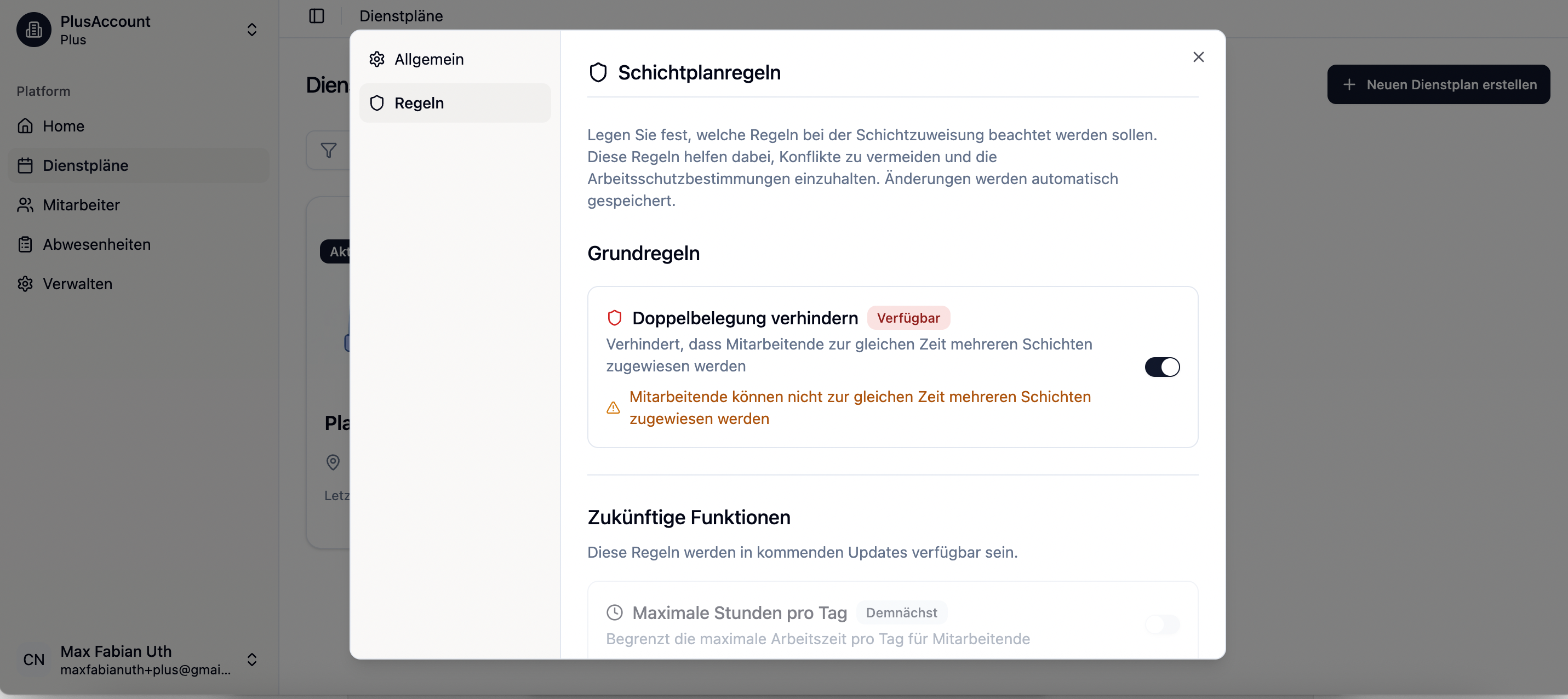 With medishift, working-time rules and rest periods are automatically tracked. Try it for free!
Shift Schedule Change Law: Special cases for illness, emergency, on-call
There are situations in which the boss's right of direction is broader. Here, too, the keyword shift schedule change law remains central — the regular 4-day grid drops out, but the limits of the Working Hours Act stay.
- Illness or emergency absence of a colleague: The boss must first check voluntary solutions before unilaterally assigning the shift. Volunteers first, then employees without compelling reasons — a blanket order "you'll do it!" rarely meets reasonable discretion.
- Official orders or pandemic situations: With quarantine or special pandemic situations, the boss can adjust the schedule at very short notice. The 11-hour rest period, however, remains untouched.
- Standby and on-call duty: If your contract includes on-call work, being pulled in is exactly the point — the on-call allowance covers that flexibility. Important: the on-call shift itself, however, must be in the schedule in time.
- No published schedule: If no binding shift schedule exists, the boss can replan up until shortly before the shift starts. That's exactly why a published schedule is also a protective barrier for you as an MFA.
- Double illness on the same day: If several colleagues are out simultaneously, the boss will try to pull in several employees. Even then, he may change the shift schedule on short notice — but extra work without notice must remain reasonable, and the 11-hour rest period to the previous shift is non-negotiable.
- Seasonal peaks (flu wave, hay-fever season): A foreseeable wave is not a "special case" in the legal sense. If you know three weeks in advance that a flu wave will hit the practice, the schedule has to be adjusted in time — not by spontaneously pulling in employees. The shift schedule change law treats foreseeability as the dividing line: predictable demand isn't an emergency.
Your rights: When changing the shift schedule violates employment law
What do you do when the boss orders a change that you consider unlawful? And when exactly does that count as "changing the shift schedule against employment law"? From real practice, three escalation steps have proven useful.
Step 1: Talk to the boss
Most conflicts can be resolved in direct conversation. Describe the concrete burden (e.g. childcare, medical appointment, already booked commitments) and suggest an alternative (colleague swap, a different day, splitting the shift). Important: document the order and your reply in writing — by email or messenger. Verbal orders are hard to prove later at a labour court. Many supervisors answer the question "can my boss change the shift schedule" surprisingly openly when you put it to them factually.
Step 2: Works council and union
If your practice has a works council, it's the first formal point of contact. The works council can object to the order — especially when co-determination has been bypassed. Anyone who systematically disregards the shift schedule change law risks a co-determination procedure all the way to the conciliation body. Many employees only ask "can my boss change the shift schedule like that?" once they've already had an unreasonable change forced on them — by then the works council is the strongest leverage you have. In smaller practices without a works council, it pays to contact a trusted colleague, a union (verdi covers the MFA field) or the relevant professional chamber.
Step 3: Employment-law advice and what you shouldn't do
If neither conversation nor internal mediation helps, get external employment-law advice from a specialist labour lawyer. Preparatory steps:
- Document the disputed order in writing (date, time, content, delivery channel)
- Write a factual written reply ("I'm raising concerns because…")
- If you take the shift despite concerns, record in writing that you're doing it "under protest" — that protects your claims.
What you should absolutely not do: refuse to show up unilaterally without announcing concerns beforehand (this can be classified as refusing to work), secretly swap with colleagues without informing the boss (any resulting damage will be on you), or escalate verbally in WhatsApp groups (this shifts the evidentiary picture to your disadvantage).
Conclusion: Handling every shift schedule change with confidence
The keyword shift schedule change law sounds like a paragraph maze, but in practice it boils down to three points (and answers the underlying question "can my boss change the shift schedule" in a structured way): First, the boss has a right of direction under Section 106 GewO, but it's limited by reasonable discretion, the Working Hours Act and collective bargaining agreements. Second, a shift schedule notice period of 4–7 days is standard; shorter changes need an objective reason and must never violate the 11-hour rest period. Third, you have clear escalation paths when the boss wants to change the shift schedule on short notice without playing by the rules — conversation, works council, advice.
A digital scheduling solution like medishift makes this easier for both sides: the schedule is demonstrably published (which avoids later disputes), changes are communicated through automatic notifications, and the integrated rule system warns about rest-period violations, double bookings or exceedances of weekly target hours. Want less conflict around the next shift schedule and more predictability for your team? Take a calm look at medishift.