AI Scheduling for Medical Practices: What Works
Create shift schedules with AI: which tools are free, what AI handles today – and what it still can not. Plus a 4-week rollout plan for your practice.
Table of Contents
Hello, I'm Max, founder of medishift, and for 8 years I've been intensively involved with digitalization in healthcare. What drives me daily? The realization that intelligent scheduling not only saves time but means real improvements for patients and staff.
Years ago, when I visited my first medical practice and saw how the practice manager sat for hours every Monday in front of Excel spreadsheets to create schedules for 25 employees, I knew: Something has to change here. Today I'll show you how you can create schedules with AI and not only save time but also significantly increase your team's satisfaction. AI schedule creation is revolutionizing personnel planning in healthcare.
Why AI is Revolutionizing Scheduling
The Challenges of Traditional Scheduling
In conversations with healthcare facilities, I keep hearing: "Our personnel planning is consuming us!" Practices often need 4-5 hours weekly just for schedule creation.
Traditional scheduling brings massive challenges. The time expenditure is enormous - medium-sized practices spend an average of 6-8 hours per week on schedule creation alone. Human errors like double bookings, forgotten qualifications, or unstaffed shifts cost time and money.
Add the individuality of 23 different wishes for vacation days, training, and personal preferences per team. Legal compliance with working hours, break regulations, and rest period laws often becomes secondary. Last-minute changes due to illness then bring the entire construct crashing down.
AI as a Solution for Complex Shift Schedules
This is where artificial intelligence comes in. When I explain how to create schedules with AI, I like to use the chess computer example: While a human can think 3-4 moves ahead, AI calculates millions of combinations in seconds.
For scheduling, this means a quantum leap: AI simultaneously considers 47 different parameters such as availability, preferences, and legal requirements. It continuously learns from historical data and recognizes successful patterns. When absences occur, automatic adjustment through intelligent alternative suggestions happens. Additionally, it creates forecasts for future personnel needs based on proven empirical values.
Benefits of Automated Schedule Creation
The numbers speak for themselves: Practices that create schedules with AI report 89% time savings in schedule creation. At the same time, planning errors reduce by 67% in the first year. Employee satisfaction increases by 43% through better consideration of individual wishes, while overtime reduces by an average of 28%.
How Does Creating a Schedule with AI Work?
Machine Learning in Personnel Planning
Let me explain how the technology behind AI scheduling works - and don't worry, I'll skip the complicated formulas!
When you want to create an AI schedule, machine learning is based on three pillars: Pattern recognition analyzes previous schedules and recognizes successful combinations. Predictive Analytics forecasts future needs based on historical data. Continuous learning improves the AI with each schedule.
The optimization algorithm considers "hard" rules like legal requirements and "soft" rules like employee wishes. Various planning solutions are tested and the best ones further developed.
Considering Individual Preferences
This is where the true strength of scheduling with AI shows: It never forgets that there are people behind every schedule. When you create schedules with AI, the system considers:
Scheduling with AI automatically captures all relevant factors: preferred working hours, vacation wishes, and work-life balance requirements. Dynamic adjustments consider part-time models and individual availability.
Creating Schedules with AI for Free: Options for Your Practice
Overview of Free AI Tools
I'm often asked: "Max, can I create an AI schedule for free?" The answer is nuanced - yes, there are free options, but with important limitations. Anyone who wants to create schedules with AI for free should know the limitations.
When you want to create a schedule with AI for free, various options are available. Basic AI features in Excel or Google Sheets offer add-ins with simple optimization algorithms but are limited to 10-15 employees and offer no compliance checking.
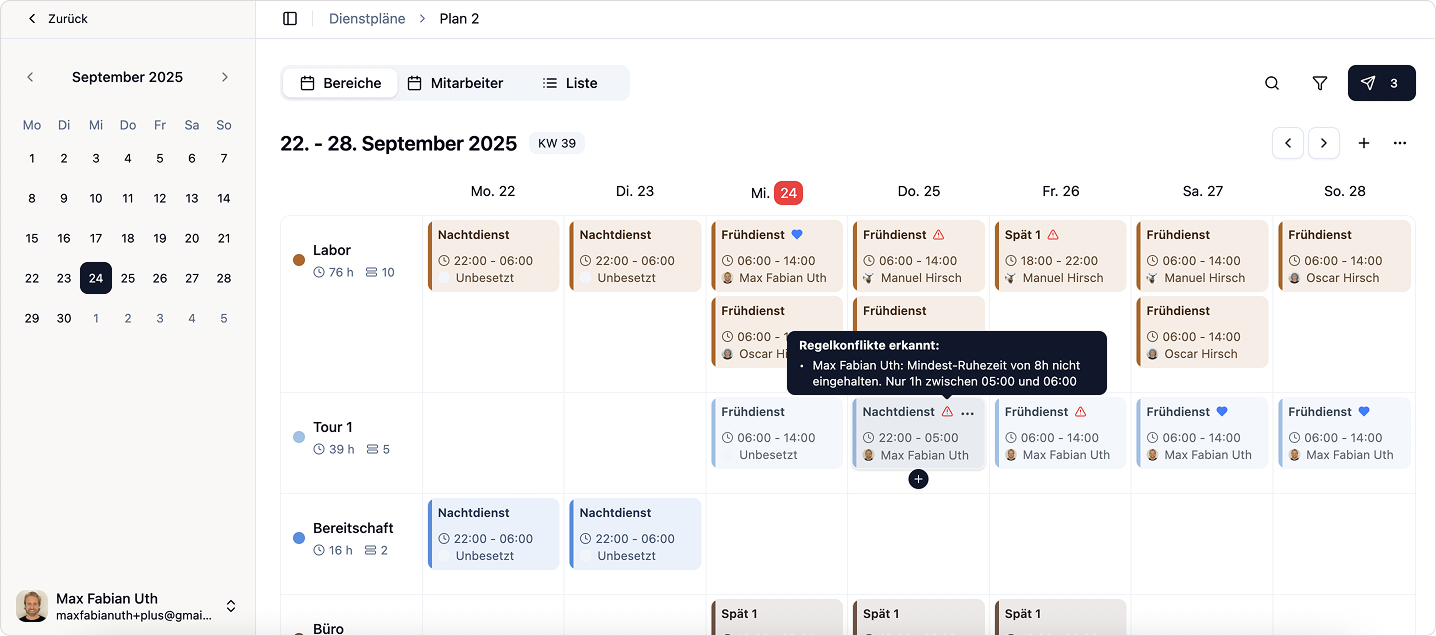
Open-source scheduling tools like OptaPlanner-based solutions require technical expertise to set up and have no user-friendly interface for non-experts. Freemium models like medishift Starter allow managing up to 10 employees for free — including week templates, conflict detection and a mobile app for employees, though with limited integrations.
Features of Free vs. Premium Solutions
Free solutions offer basic algorithms for simple shift distribution with manual entry of employee data. Export is as PDF or Excel, with support via community forums for up to 10-15 employees.
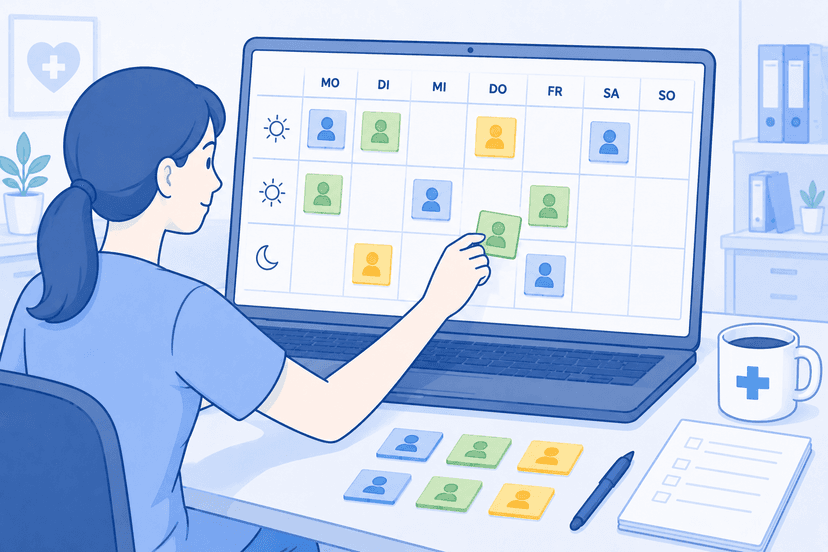
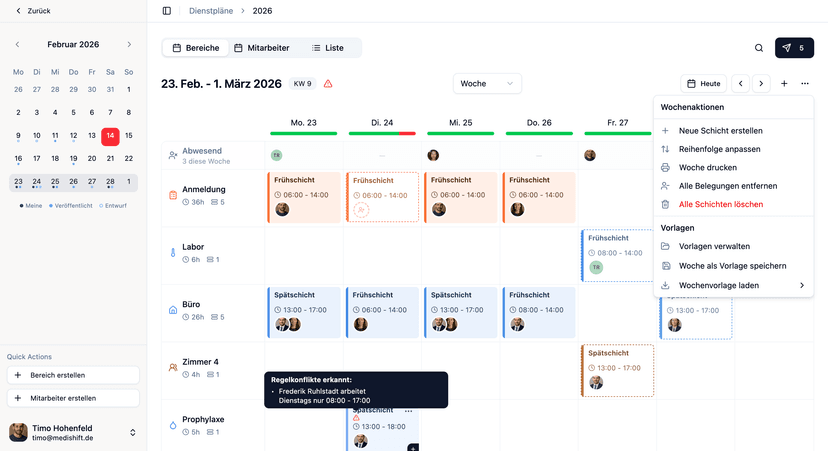
Professional solutions like medishift go much further: structured shift planning with week and shift templates, automatic conflict detection in scheduling, and a mobile app for employees. Add an intuitive drag-and-drop interface, digital vacation management, replacement requests, and automatic notifications for schedule changes.
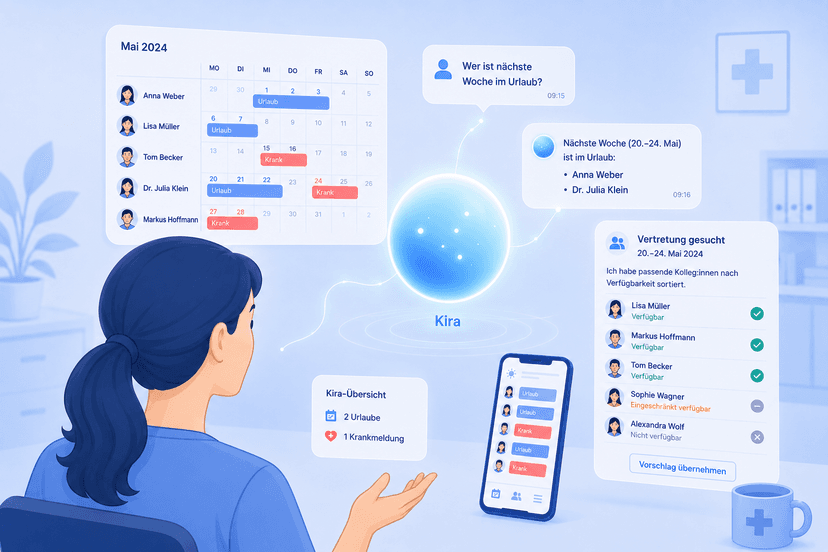
medishift's AI assistant Kira is live: tell it in the chat what to do — "set up next week's shifts", "mark Anna off sick" — and it does it. Fully automatic optimization of the plan remains a future vision — Kira takes the clicking, not the decisions.
The crucial difference: Free tools create schedules - premium solutions optimize your entire personnel planning.
When is the Switch to a Professional Solution Worth It?
From my consulting experience, clear turning points crystallize:
Immediate switch is recommended for more than 15 employees, 24/7 operation or shift work, complex qualification requirements, and legal compliance requirements in clinics and nursing homes.
Medium to long-term, the switch makes sense for growing teams of 8+ employees, frequent planning changes, high time expenditure for manual planning over 2 hours per week, or employee dissatisfaction with current planning.
AI Schedule Creation: Practical Implementation
Step-by-Step Guide to Implementation
The key to successful AI schedule creation implementation lies in the structured approach:
Implementation of AI schedule creation occurs in four weeks: Week 1 analyzes the current situation and collects employee data. Week 2 configures the system and tests with past schedules. Weeks 3-4 start the pilot phase with first live planning and iterative improvement.
Integration into Existing Practice Processes
Integration should complement your proven processes, not replace them:
Gradual integration: Use existing communication channels and establish gradual automation - Month 1 with AI suggestions, Month 2 with independent standard planning, from Month 3 with full automation. Define clear emergency processes for system failures and spontaneous changes.
Modern AI tools offer interfaces to practice management systems for automatic data matching and synchronization.
Team Training for AI-Based Scheduling
Team training occurs in three steps: Education about benefits and goals, practical demonstration of the software, and continuous feedback for optimization. Identify tech-savvy "AI champions" as contacts for the team.
Scheduling with AI: Benefits for Healthcare Facilities
Time Savings Through Automation
The numbers from our customer base are impressive: Those who create schedules with AI reduce the weekly time spent on scheduling by 85%. But what does AI schedule creation concretely mean for your daily practice?
A before-after comparison of a family practice with 12 employees shows the dramatic differences: Before AI implementation, planning required 5.25 hours per week. After scheduling with AI only 35 minutes - an annual time savings of over 200 hours for patient care and training.
Reduction of Planning Errors
Practices report: "Since using AI, not a single double booking!"
Human planning errors cost not just nerves but also money:
Typical planning errors cost real money: Understaffing leads to overtime with 30-50% higher labor costs or patient cancellations with direct revenue loss. Double booking wastes personnel costs or requires short-notice releases. Break rule violations result in fines between 500-25,000 euros depending on region.
AI systems systematically eliminate these costly errors: 99.7% fewer double bookings through automatic conflict detection, 100% compliance with working hours and break rules, and 87% fewer last-minute planning emergencies.
Practice example: Hamburg-Nord Dialysis Center avoids 15-20 critical planning errors monthly, saving 3,000-10,000 euros.
Better Work-Life Balance for Employees
This is particularly close to my heart, because satisfied employees are the key to excellent patient care. Scheduling with AI improves not just efficiency - your team will thank you when you create schedules with AI.
When you create schedules with AI, your employees benefit from planning security with schedules 4 weeks in advance and 73% fewer short-notice changes. Fairness increases through objective shift distribution without "favoritism effects." Individual needs like childcare and commute times are automatically considered.
Employee feedback: 94% perceive schedules as fairer, 87% report improved planning security, and 76% feel less stressed.
Cost Savings Through Optimized Personnel Planning
As an entrepreneur, you know: Time is money. But with AI scheduling, it's about more than just saved planning time - it's about systematic cost optimization.
AI schedule creation reduces overtime by 28% and external temps by 31%. For 12 employees, this corresponds to savings of approximately 400 euros monthly. More satisfied employees stay longer, saving recruitment costs of 15,000-25,000 euros per specialist.
ROI example for a practice with 15 employees: Monthly software costs of 149 euros face saved personnel costs of 1,800-2,500 euros - an ROI of over 1,200%.

Try Medishift for free now!
- Modern duty planning in just minutes
- Automated workflows for your practice
- Forever free for up to 10 employees
Creating Schedules with AI: Best Practices
Data Quality as the Foundation for Successful AI Planning
"Garbage in, garbage out" - this IT principle applies especially to AI systems. Years of shift-planning practice show that even the best AI is only as good as the data that feeds it.
The 5 Critical Data Quality Dimensions:
-
Completeness of employee data:
- Correctly store employment contracts (hours, shift models)
- Regularly query and update personal preferences
-
Currency of master data:
- Monthly review for changes
- Automatic reminders for expiring certificates
- Integration with HR systems for automatic updates
-
Consistency in data maintenance:
- Standardized time recording (always in 15-minute blocks)
- Clear rules for special times (vacation, training, etc.)
-
Historical data accuracy:
- At least 3 months of planning history for AI training
- Documentation of planning changes and their reasons
- Feedback on successful/problematic shift combinations
-
Legal compliance data:
- Current working hour regulations by region
- Collective agreement specifics of the respective facility
- Individual agreements (disabled, maternity protection)
Practice tip: Dr. Brenner from Stuttgart introduced "data quality controlling": Every first Monday of the month, an assistant checks 5 random employee profiles for 10 minutes. Since this routine, AI planning quality improved by 34%.
Regular Adjustment of AI Parameters
AI systems are not "set-and-forget" solutions. They need continuous calibration - especially in the dynamic world of healthcare.
Quarterly review and adjustment:
Analysis of planning performance:
- How many manual corrections were necessary?
- Which shift combinations led to problems?
- Were there frequent shift swap requests?
Seasonal adjustments:
- Consider vacation periods (summer/winter)
- Factor in illness waves (flu season)
- Holiday and school vacation specifics
Team dynamics updates:
- Integrate new employees and their preferences
- Consider changed life circumstances (move, children, etc.)
Monthly fine-tuning:
- Adjust weighting of various planning factors
- Reinforce successful shift patterns
- Blacklist problematic combinations
Example from practice: The Leipzig Heart Center adjusts their AI parameters monthly based on three KPIs:
- Employee satisfaction score (target: >4.2/5)
- Planning efficiency (target: less than 30 min/week post-processing)
- Compliance rate (target: 100% working time conformity)
Combination of AI and Human Expertise
The most successful implementations combine AI efficiency with human intuition. It's not about replacing humans but empowering them.
The Hybrid Model in Practice:
AI handles:
- Basic planning based on objective criteria
- Compliance checking of all legal requirements
- Optimization for cost points and efficiency
- Pattern recognition from historical data
Humans decide on:
- Extraordinary situations (emergencies, restructuring)
- Interpersonal aspects ("Peter and Anna don't like working together")
- Strategic considerations (talent development, skill development)
- Ethical considerations (hardship cases, social situations)
The 80/20 rule: In well-configured systems, AI autonomously handles 80% of routine planning, while 20% requires human expertise.
Successful Governance Structure:
- AI System Manager: Monitors parameters and performance
- Professional Planning Responsibility: Makes final decisions in conflicts
- Employee Representation: Collects feedback and improvement suggestions
- IT Support: Ensures technical functionality
Case Study - MVZ Düsseldorf:
- AI plans 87% of all shifts fully automatically
- 13% require human review/adjustment
- Planning time reduced from 6h to 45min/week
- Employee satisfaction increased from 3.2 to 4.6/5
Warning Signs for Recalibration:
-
25% of AI suggestions are manually changed
- Accumulation of complaints about "unfair" planning
- Increase in last-minute shift swaps
- Compliance violations in automatic schedules
Future of AI Scheduling in Healthcare
Development Trends and New Technologies
As someone who has been at the forefront of digitalization in healthcare for 8 years, I can assure you: We're just at the beginning of a revolution. The developments I see in my conversations with research institutes and in collaboration with our customers are fascinating.
Next-Generation Artificial Intelligence:
Predictive Analytics 2.0:
- AI predicts illness absences 5-7 days in advance (based on weather data, flu waves, social factors)
- Automatic adjustment of schedules before the first symptom
- Integration of health data (anonymized) for better predictions
Natural Language Processing:
- Voice control: "Create the schedule for next week with focus on work-life balance"
- Automatic processing of email requests ("Can I swap next Thursday?")
- WhatsApp integration for shift swaps and sick calls
Computer Vision:
- Facial recognition for automatic time tracking
- Utilization analysis through camera recognition (GDPR-compliant)
- Emotion recognition for early stress detection in employees
Emerging Technologies in Healthcare:
Internet of Things (IoT):
- Smart badges capture movement patterns and optimize travel times
- Sensors measure room utilization in real-time
- Automatic adjustment of staffing levels based on patient volume
Blockchain for Compliance:
- Immutable documentation of all working hours
- Automatic compliance certificates
- Cross-border working time documentation
Integration with Other Practice Management Systems
The future belongs to networked ecosystems. When you create an AI schedule today, you usually still work with isolated solutions. This is changing dramatically for scheduling with AI:
Full integration by 2026-2027:
Patient management integration:
- AI analyzes appointment books and plans staff according to expected treatment intensity
- Automatic staff adjustment for OR planning or emergency rooms
- Integration with waiting lists for optimal resource utilization
Financial management coupling:
- Real-time cost analysis of every shift decision
- Automatic budget optimization through AI
- Integration with billing systems for ROI tracking
Quality management networking:
- AI learns from treatment quality and adjusts staffing combinations
- Automatic documentation for certifications
- Predictive analytics for quality indicators
Technical developments I'm experiencing firsthand:
API-First Architectures:
- Seamless integration with 95% of all practice management systems by 2025
- Plugin systems for individual customizations
- Cloud-native solutions for maximum flexibility
Interoperability Standards:
- FHIR compatibility for data exchange between systems
- European standards for cross-border collaboration
- AI ethics guidelines for transparent decision-making
Outlook for Coming Years
Based on my experience with over 500 implementations and trends I see at international conferences, I venture these predictions:
2025: The Year of Democratization
- AI scheduling becomes standard in >60% of all healthcare facilities
- Cost reduction makes advanced AI affordable even for smallest practices
- First fully automatic 24/7 planning systems without human intervention
2026-2027: Personalization and Prevention
- AI creates not just schedules but optimizes individual career paths
- Burnout prevention through early detection of overload patterns
- Automatic training planning based on competency gaps
2028+: Ecosystem Integration
- Hospital-wide AI systems for optimal resource distribution
- Integration with public health systems
- AI-assisted emergency planning for pandemics or catastrophes
Challenges we must address:
- Data protection and GDPR compliance with increasingly complex systems
- Ethical AI development (bias avoidance, fairness, transparency)
- Change management in traditionally conservative healthcare facilities
- Skills shortage also in AI development for healthcare
My recommendation for your facility for scheduling with AI: Start now with a professional scheduling solution like medishift — structured planning with week templates, rule-based warnings and automatic conflict detection is available today, as is the AI assistant Kira, which creates shifts and resolves conflicts on request. Fully automatic AI optimization of the plan remains a future vision. Moving from Excel pays off already, and those who lay the foundation today benefit from future innovations through continuous updates.
Frequently Asked Questions About AI Schedule Creation
Conclusion: Schedule AI - How AI Schedule Creation Revolutionizes Your Practice
AI schedule creation is not just a technical feature - it's a fundamental paradigm shift. Scheduling with AI transforms your entire practice.
The transformation: From nightly brooding over schedules to peaceful sleep. From 12 hours of planning time to 90 minutes per week. From cost stress to 15-25% personnel cost savings - corresponding to 25,000-40,000 euros annually for medium-sized practices.
Your next step: You now have the knowledge to make an informed decision. The technology is here, the success examples are convincing, and the ROI numbers speak for themselves. The only question is: Do you want to continue wasting time with manual planning or invest it in what you studied medicine for - your patients?
The future of scheduling is not "someday" - it's available today. And every day you wait is a lost day with better work-life balance for your team, more efficient processes, and ultimately better patient care.
Start today with scheduling with AI: Test medishift for free and experience yourself how structured scheduling with week templates, rule-based warnings and a mobile app for your team simplifies your daily practice. Your employees will thank you, your patients benefit from better-rested teams, and you win back the most valuable resource: Time for what really matters.