
Vacation Planning: The Complete Guide for Teams in 2026
Vacation planning in a medical practice means balancing staff wishes, minimum coverage and the German Federal Holiday Act. Here is how to plan it fairly, legally and without spreadsheet chaos.

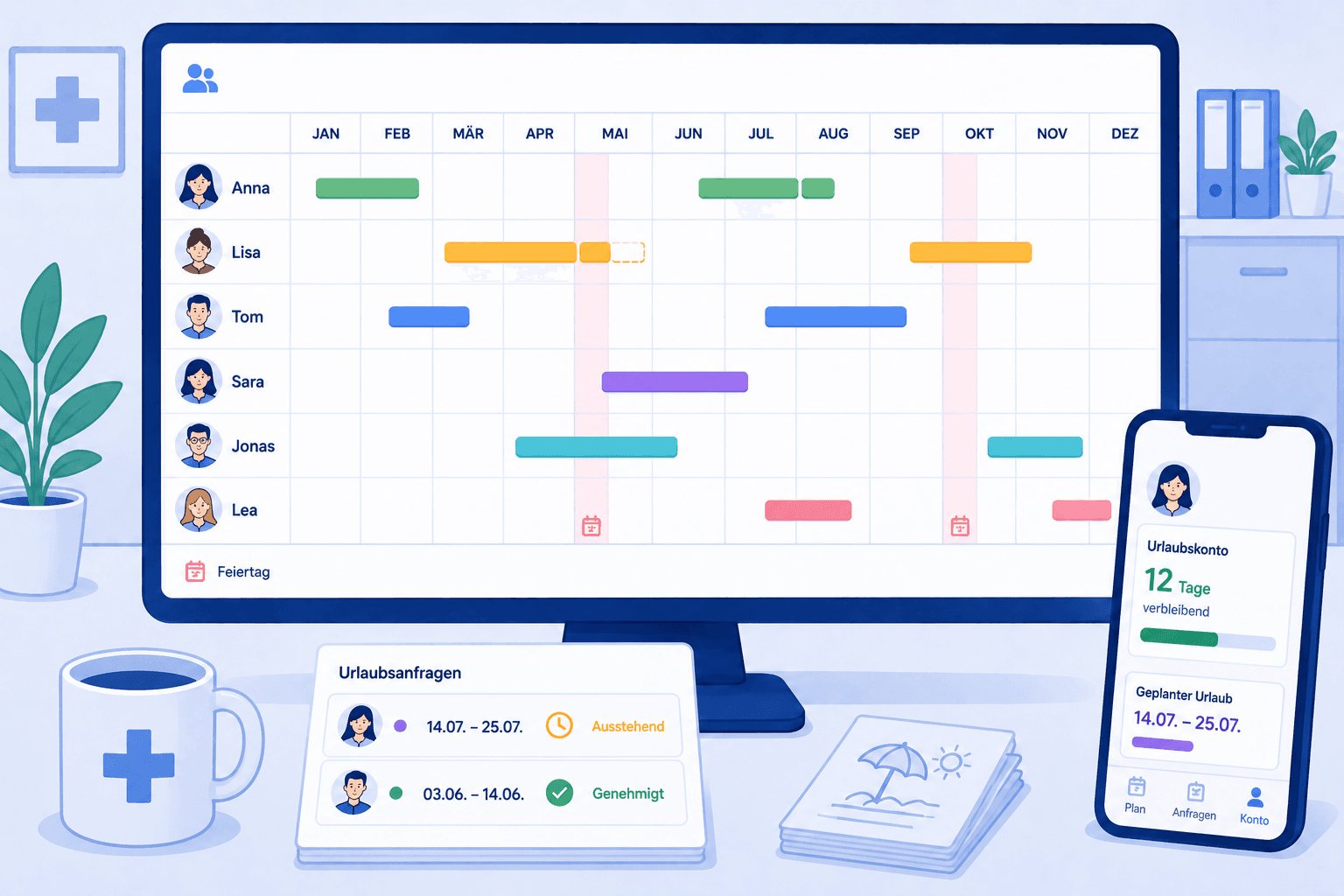
Vacation planning in a medical practice means juggling the wishes of your medical assistants, the minimum coverage needed at the front desk and the rules of the German Federal Holiday Act all at once. This is the point where a year either stays predictable or turns every holiday week into a negotiation. This guide shows you how vacation planning works across a team, which rights and duties apply, and how to move from a fragile spreadsheet to a reliable leave account.
We focus on the German healthcare sector, because the demands there are unusually tight: small teams, almost no buffer when someone is out, and a high expectation of reliability towards patients. Much of it, though, transfers to any team with a fixed minimum staffing level.
What is vacation planning?
Vacation planning is the process by which a team distributes its employees' paid leave across the year without harming the ability to operate. It covers three tasks at once: collecting and weighing vacation wishes, granting binding approval, and continuously updating each leave account. At its core it reconciles two legitimate interests, the need of employees to rest and the operational readiness of the practice.
A good vacation plan answers three questions at any time: Who is absent and when? How many vacation days does each person still have open? And is the minimum staffing level secured in every work area? As long as these questions have reliable answers, planning runs smoothly. The moment one of them wobbles, conflicts appear: double-booked weeks, forgotten remaining days, or a surprisingly empty reception during the summer holidays.
It is worth distinguishing vacation planning from mere absence tracking. Recording who happens to be off today is not yet planning. Planning means steering ahead: setting blackout periods, distributing wishes fairly and spotting bottlenecks before they happen. Vacation planning software supports this, but it does not replace the management decision about who actually gets a heavily requested week off.
For very small teams, an Excel vacation planner or even a wall calendar is enough for a long time. But as soon as several people, blackout periods, carry-over balances and statutory notice duties come together, manual upkeep becomes fragile. That is exactly when the friendly little list turns into a real planning topic.
Excel vacation planner or software: when the switch makes sense
The question "Excel or software" is rarely asked at the right moment. It is too early when the team has two people and the vacation plan fits on a postcard. It is too late when two employees have already travelled at the same time twice and the front desk stood empty.
The most reliable sign is the effort the list takes to maintain. If you regularly recalculate remaining vacation by hand at year end, if requests arrive through three different channels, and if nobody can say for sure which spreadsheet version is current, then the file has outlived its usefulness. A second hard indicator is visibility: as soon as employees cannot check their own leave balance, every question lands back with management.
Two advantages speak for the table at the start: it is free and immediately familiar. Both count for less the more special cases pile up. Most vacation planning tools today offer a free entry tier for small teams or a full trial, and onboarding for the management role usually takes under an hour.
There is a third, often overlooked path: parallel use. Some teams keep a slim Excel template as a print layout or notice, but plan actively only in the software. That is legitimate as long as it is clear which system is the source of truth. The moment both are actively maintained, you invite consistency problems that are worse than either solution on its own.
How to approach vacation planning
A vacation plan that holds up all year is not built under time pressure in January; it follows a recurring routine. The steps below have proven themselves in many practices and work regardless of the tool you use.
The cycle starts with clear principles and ends with the clean carry-forward of remaining days. What matters is that each step is documented and traceable, because that protects you in case of conflict and makes decisions transparent for the team. The five steps below summarise the loop that a working vacation planning process runs through every year.
Order is decisive: first the rules, then the entitlement data, then collecting the wishes, and only then approval. Anyone who reverses this and approves vacations before blackout periods and minimum coverage are defined will end up withdrawing approvals, which always lands badly with the team. Plan the main run once a year, ideally in autumn for the coming year, and handle only individual requests during the year.
In practice, a fixed cut-off date by which all wishes for the following year must be submitted, say the end of October, works well. By then everyone enters their preferred periods, and afterwards you moderate the overlaps in one round instead of negotiating each request separately. That saves time and takes the randomness out of the distribution. Wishes that arrive after the cut-off are treated as regular individual requests, approved only if minimum coverage allows. With this rhythm the rough plan for the year is fixed early, and the team can plan trips and family time reliably.
Understanding the leave account: entitlement, remaining vacation and carry-over
The heart of every vacation plan is the leave account, the running balance of entitlement and days taken. The formula behind it is simpler than it often feels in daily work: available days are the annual leave plus any carry-over from the previous year, minus the already confirmed vacation days. Pending, not-yet-approved requests do not reduce the entitlement; they are merely reserved. Map this principle cleanly and you know at any moment how many days each person can still freely dispose of.
The annual leave follows from law, collective agreement or contract. The Federal Holiday Act sets the floor at 24 working days [1], and many healthcare contracts go above it. If someone joins or leaves during the year, the entitlement is calculated pro rata, one twelfth of the annual entitlement per full month of employment. This partial calculation is one of the most common sources of error in spreadsheets and a good argument for a system that handles it automatically.
With remaining vacation, precision pays off. As a rule, vacation must be taken within the current calendar year. A carry-over into the following year is only permitted for operational or personal reasons, and the carried days then usually have to be taken in the first months of the new year. In practice this means anyone who discovers remaining days only in December often already has a problem, because several people want to be off at once. An automatic leave account carries these balances forward without manual work and surfaces open days early, so you can steer in good time.
Equally important is the clean handling of half-days and special cases. A half vacation day, a public holiday in the middle of a vacation week, or a sick note submitted retroactively during vacation all change the balance. When such cases are maintained by hand, rounding errors creep in. A solution that automatically excludes calendar days, weekends and location-specific public holidays keeps the account reliable without you checking every booking.
Legal foundations: BUrlG, ArbZG and case law
Vacation planning operates within a clear legal framework shaped by three sources. Knowing it lets you plan not only more fairly but also more safely.
The Federal Holiday Act is the foundation. It prescribes a statutory minimum vacation of 24 working days per year, which on a five-day week equals 20 working days [1]. Working days here means all days except Sundays and public holidays. Collective agreements and individual contracts often grant more, but you may not fall below the statutory floor. The act also states that employees' vacation wishes must be considered unless urgent operational concerns or the priority wishes of other colleagues conflict with them [1].
On the question of when vacation expires, the Federal Labour Court has sharpened the standard considerably. Under current case law, untaken vacation only expires at year end if the employer has previously asked employees concretely to take their leave and warned them in good time of the impending forfeiture [3]. Without this documented notice the entitlement remains and can accumulate over several years. For practice, this means a mere deadline in the calendar is not enough; the notice must be demonstrable.
The Working Hours Act comes into play as soon as vacation triggers cover. When a colleague takes over the shifts of the absent person, the daily maximum working time and the uninterrupted rest period of at least 11 hours must still be observed [2]. Good vacation planning therefore thinks about cover as well and does not quietly push the burden onto a few shoulders. In addition, collective frameworks such as the collective bargaining agreement for medical assistants often regulate extra vacation entitlements and special leave beyond the statutory minimum.
A useful overview of the legal framework is also provided by the Federal Ministry of Labour and Social Affairs [4]. Anyone who wants to dig deeper into specific employment-law questions will find the relevant rulings in the decision archive of the Federal Labour Court [3].
Vacation planning across a team: how many may be off at once?
The most common friction in vacation planning arises not from the single request but from simultaneity. Summer holidays, bridge days and the weeks between the years attract wishes like a magnet. Without rules, you distribute by who shouts loudest and end up annoying everyone.
The first lever is a defined minimum staffing level per work area. You set how many people must be present at reception, in the lab or in the treatment room for the operation to run. This number is the hard limit against which every vacation approval must be measured. Software makes it visible by warning as soon as too many absences overlap in the same period.
The second lever is fairness over time. Popular weeks like the summer holidays cannot be granted to everyone every year. A rotating principle works well: whoever had the main holiday weeks off this year steps back next year. Document this rule, and the decision becomes traceable rather than personal. Blackout periods round out the picture, for example a deliberately vacation-free week around a practice move or a certification.
The third lever is bridge days. They are so sought after that they deserve their own rules. Some teams draw lots, others allocate by submission date, others tie the bridge day to a full vacation day. Which variant you choose matters less than the fact that the rule is fixed in advance and applies to everyone.
Rollout: from the spreadsheet to a digital leave account
Moving from a spreadsheet to vacation planning software is less an IT project than a change in everyday work. Prepared well, it is behind you in a few weeks.
In the first phase you transfer the master data: per person the annual leave and the carry-over from the previous year. This is the basis of the leave account, which from now on is updated automatically. In this step, also check the stored public holidays, because they must match the location. Solutions that support multiple locations with their own region import the right holidays for Germany, Austria and Switzerland automatically.
In the second phase you define the absence categories. Common ones are vacation, sickness, training, special leave and parental leave. For each category you decide whether it is deducted from the leave account and whether it counts as working time. Configure this cleanly once and the calculation runs on its own afterwards.
In the third phase you bring the team on board. Employees see their leave account in their own dashboard, with booked, approved and still pending absences. They submit requests themselves, and approval runs through management. This self-service is the biggest lever for acceptance, because it removes the endless "how many days do I have left?" questions. Plan a little extra time for the first real vacation round and provide a short hand-out that explains the request path.
Common pitfalls and how to avoid them
Even with careful planning, certain pitfalls keep recurring. Four of them are especially costly.
The forgotten forfeiture notice. Anyone who fails to ask employees to take their leave in documented form risks vacation entitlements piling up over years, simply because they do not expire [3]. The fix: one written reminder each autumn to everyone with open remaining days, with a clear deadline and a note about forfeiture. Software that shows open balances makes this step easy.
No defined minimum coverage. Without a clear floor per work area, every vacation approval becomes a gut decision. The fix: set a minimum figure for each area and check vacations consistently against it. That keeps the practice operational even in peak holiday season.
Requests across many channels. When vacation is requested by chat, email and word of mouth, no reliable source emerges. Sooner or later the lists contradict each other. The fix: a single request path, ideally with self-service, so that every request with its period and balance lands in one place.
Looking at remaining vacation only in December. Anyone who checks balances only at year end gets nasty surprises when several people suddenly have to take their remaining days at the same time. The fix: keep the leave account in view continuously and plan remaining days early rather than pushing them into the final quarter.
Vacation planning in practice, care services and hospitals
Depending on the setting, the emphasis of vacation planning shifts noticeably. The basic principles stay the same; the requirements differ.
In the medical practice, the small workforce dominates. Every medical assistant is scheduled, and there is hardly any buffer. Here the fair distribution of the main holiday weeks and a clear minimum staffing level at reception matter most. Because the lines are short, much can be settled in direct conversation, yet traceable documentation protects against any impression of arbitrariness.
In the care service, vacation is closely tied to route planning. An approved absence must appear in the deployment plan immediately, so that nobody is assigned to an already planned route. Coordinating across several routes and sometimes several locations is the real effort.
In the hospital, the complexity of shift operations is added. Vacation must neither expose the early shift nor concentrate on-call duty on too few people. Here the connection between vacation and shift planning is not a luxury but a prerequisite. Collective-agreement rules and ward-specific staffing requirements make planning demanding and reward a system that carries approved vacation into the roster automatically.
Providers and selection criteria in the German market
The German market for vacation and absence planning is broad: from pure vacation planners through comprehensive HR suites to solutions that map vacation and roster in one system. For practices and care services, it is worth looking at providers that understand healthcare.
Medishift positions itself at exactly this intersection by connecting absence and shift planning. The automatic leave account carries available, approved and pending days forward per employee and year, accounts for public holidays and fixed deployment times, and allows carry-overs into the following year. Vacation requests run through an approval logic in which absences created by management apply immediately while those submitted by employees are initially pending. For company holidays, bulk absences can be created for the whole team in a single step. Hosting is in Germany and GDPR compliance is documented.
Other providers set different priorities, such as deep payroll integration, a broad HR module or pure vacation administration without any shift connection. The right choice depends on how tightly vacation and roster are linked for you. The more directly absence has to feed into shift planning, the more valuable a system that maps both under one roof.
Four hard criteria help when evaluating: an automatic leave account that carries remaining days and transfers forward without manual work; an overlap warning that protects minimum coverage; a view for employees that reduces questions; and hosting in Germany or at least the EU with documented GDPR compliance. Anyone covering these four points is a serious option; everything else is fine-tuning.
Summary
Vacation planning is more than ticking off wishes: it is the recurring annual task of balancing rest and operational readiness fairly and legally. The Federal Holiday Act sets the floor with the statutory minimum [1], the Federal Labour Court obliges you to give documented notice of impending vacation forfeiture [3], and the Working Hours Act applies wherever vacation triggers cover [2].
For very small teams, an Excel vacation planner is enough for a long time. As soon as blackout periods, minimum coverage, carry-over balances and statutory notice duties come together, spreadsheets become fragile. Vacation planning software updates the balances automatically, warns about overlaps and makes the plan visible to everyone. If you set clear principles, involve the team through a leave account and plan remaining days early, the year stays predictable, and the next summer holiday round becomes routine instead of a negotiation.
Comparison
| Aspect | Excel vacation planner | Vacation planning software |
|---|---|---|
| Remaining-vacation calculation | Manual formulas, error-prone | Automatic leave account per employee |
| Public holidays and weekends | Enter and maintain yourself | Counted automatically, per location |
| Vacation requests | By email, note or word of mouth | Request with approval logic in the system |
| Overlaps within the team | Visual check only | Overlap warning when entering |
| Visibility for employees | File has to be shared | Own leave account in the dashboard |
| Company holidays and practice closures | Enter for each person separately | Bulk absence in a single step |
| Carry-over into the next year | New file, transfer by hand | Automatic annual carry-over |
How to do it
- 1
Define vacation principles and blackout periods
Before the first request arrives, set the ground rules: by when must vacation wishes for the coming year be submitted, which weeks are blackout periods, and how many people may be absent at once per work area? Putting these principles in writing saves you many case-by-case discussions later.
- 2
Record annual entitlement and carry-overs
For each employee, enter the individual annual leave and any carry-over from the previous year. This is the basis of the leave account. Start cleanly here and you will have reliable balances all year and avoid laborious recalculation at year end.
- 3
Collect vacation requests centrally
Instead of gathering wishes by word of mouth, chat and notes, route every request through one channel. Ideally the employee submits the request themselves, and you immediately see the period, the remaining leave account and any conflicts. That way no parallel shadow list emerges.
- 4
Check conflicts against the roster and the team
Before approving, reconcile the request against minimum coverage and already approved absences. If too many vacations overlap in one week, decide by clear criteria communicated in advance, for example by submission date or on a rotating basis across the years.
- 5
Approve and carry remaining vacation forward
With approval the vacation becomes binding, the leave account is reduced automatically and everyone sees the current status. At year end you review open remaining days, ask employees to take their leave in documented form, and carry over only what is legally permitted.
For your practice
For medical practices
In a medical practice, vacation planning collides with a small, tightly scheduled workforce. If one medical assistant is out, the gap is felt immediately at reception or in the treatment room. That makes reliable blackout periods in peak season, a fair distribution of holiday weeks across the team and a clear minimum staffing level per day essential. A leave account that tracks remaining vacation and carry-overs automatically helps, as does a view that shows at a glance who is off and when. That keeps the consulting hours predictable.
For care services and hospitals
In care services and hospitals, vacation planning is tightly interwoven with shift operations. Vacation must not leave an early shift unstaffed or load on-call duty onto too few shoulders. Here the link between absence and shift planning matters: approved vacation has to appear in the schedule instantly, so nobody is rostered onto an already absent person. Multiple locations, location-specific public holidays and collective-agreement rules add further complexity that rewards a connected system.
Frequently asked questions
Related articles

Vacation Planning Medical Practices: Guide 2026
Efficient vacation planning in your medical practice 2026. Tips for annual leave scheduling, creating vacation schedules, and optimal team coordination.

Advance Vacation Planning Rights: Rules & Deadlines
Advance vacation planning rights explained: how early the leave schedule must be finalized, what the German BUrlG actually says, and what rights you have as an employee or practice owner. All rules and practical tips for medical practices.
Sources
This content references the following public sources:
- [1]Federal Holiday Act (BUrlG) — Federal Ministry of Justice (2024-01-01)
Full text of the German Federal Holiday Act, including the minimum of 24 working days, carry-over rules and fulfilment of the vacation entitlement.
- [2]Working Hours Act (ArbZG) — Federal Ministry of Justice (2024-01-01)
Rules on maximum working time, rest periods and breaks that must be observed when arranging cover during vacation periods.
- [3]Decisions of the Federal Labour Court — Federal Labour Court (2024-03-15)
Decision archive of the German Federal Labour Court, including rulings on the employer duty to inform staff about impending vacation forfeiture.
- [4]Vacation – Overview by the BMAS — Federal Ministry of Labour and Social Affairs (2024-06-01)
Overview page of the German Federal Ministry of Labour and Social Affairs on the statutory vacation entitlement and its conditions.
- [5]Labour market: people employed in healthcare — Federal Statistical Office (2025-06-01)
Statistics from the German Federal Statistical Office on employment trends in the German healthcare sector.
- [6]Practice management — National Association of Statutory Health Insurance Physicians (2025-01-01)
Overview page of the KBV on practice management, with notes on staffing and organisation in statutory healthcare.